Darussalam PK
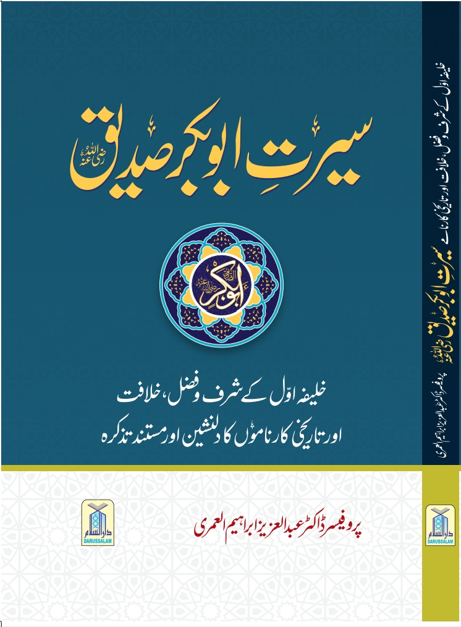
Seerat e Abubakr (R.A) (New Addition)
Publisher: Darussalam
Rs.1,400.00
Tax included. Shipping calculated at checkout.
Currently out of stock
Notify me when available
We'll email you the moment this is back in stock.
You're on the list! We'll email you when it's back.
You Might Also Like
Standard Delivery
3–5 working days
Fast Dispatch
Order before 1 PM — ships same day
Authentic Titles
Official Darussalam publications
Secure Checkout
SSL encrypted · Trusted by 50,000+
Secure Payment:
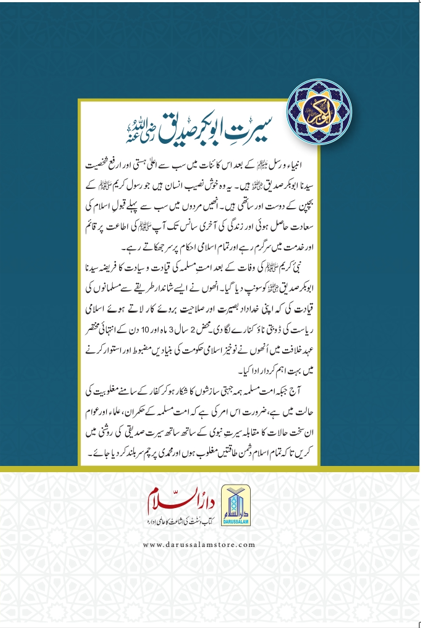
Abu Bakr (R.A) — born Abdullah ibn Abi Quhafa — was a wealthy Makkan cloth merchant and the Prophet Muhammad (peace be upon him)'s closest friend before either of them had heard of revelation. When the Prophet (PBUH) began preaching Islam, Abu Bakr was the first free adult man to accept it, without hesitation. He later earned the title As-Siddiq, "the testifier of truth," after publicly affirming the Isra and Mi'raj — the Prophet's night journey to Jerusalem and ascension — at a moment when many in Makkah refused to believe it. This edition, written by Prof. Dr. Abdul Aziz Ibn Ibraheem Al Omary, covers his life from that early conversion through his two years as the first Caliph of Islam.
From merchant to first believer
Before Islam, Abu Bakr was already a respected figure in Makkah — a trader known for honesty in his dealings, which is part of why his word carried weight once he began inviting others to Islam. Uthman ibn Affan, Zubayr ibn al-Awwam, Abdur Rahman ibn Awf, Sa'd ibn Abi Waqqas, and Talha ibn Ubaydullah — five of the ten companions promised Paradise — all accepted Islam partly through his direct invitation. He also used his wealth to purchase and free Muslims who were being tortured for their faith by their owners, among them Bilal ibn Rabah, who went on to become the first mu'adhin (caller to prayer) in Islam.
The cave of Thawr and the Hijra
When the Prophet (PBUH) was commanded to migrate from Makkah to Madinah in 622 CE, Abu Bakr was the one who accompanied him — the only companion mentioned by name in the Quran for this journey, referred to as "the second of two, when they were in the cave" (Surah At-Tawbah, 9:40). The two hid in the cave of Thawr for three days while Quraysh search parties looked for them, and it was Abu Bakr who funded the journey, arranged the guide, and stood between the Prophet (PBUH) and danger more than once along the way. The book covers this episode in detail, along with the years of persecution that preceded it.
Saqifah and the first Caliphate
Following the Prophet's (PBUH) death in 632 CE, the Muslim community faced its first real test of continuity. At a gathering known as Saqifah Bani Sa'idah, Abu Bakr was chosen as Caliph — a decision the book presents alongside his inaugural address to the Muslims, in which he told them plainly: "I have been given authority over you, and I am not the best of you. If I do well, help me; if I do wrong, set me right." That combination of authority and humility is a recurring theme through the rest of his rule.
The Ridda Wars: holding the Ummah together
Almost immediately after the Prophet's (PBUH) death, several Arab tribes renounced Islam or refused to pay zakat, and a handful of false prophets emerged claiming revelation of their own. Abu Bakr's response — the Ridda Wars, fought largely under the command of Khalid ibn al-Walid — is often treated as the decisive moment that kept the Muslim state from fragmenting in its first year. The book covers why Abu Bakr insisted on fighting these campaigns even when some senior companions urged caution, and how the outcome set the stage for the expansion that followed under Umar (R.A).
Preserving the Quran
Many of the Muslims who had memorized the Quran in full were killed at the Battle of Yamama during the Ridda Wars, which raised a real concern about losing parts of the text as living memory faded. On Umar's advice, Abu Bakr commissioned Zaid ibn Thabit to collect the Quran into a single written mushaf, cross-checked against multiple memorizers and written fragments. That compiled copy is the direct ancestor of the Quran as it exists today — a project the book treats as one of Abu Bakr's most consequential decisions, even though it happened away from any battlefield.
Character and daily life as Caliph
Despite ruling over a growing state, Abu Bakr kept the habits of an ordinary Madinan: he continued milking goats for a neighboring household who couldn't do it themselves, and he initially refused any salary for serving as Caliph, agreeing to draw one from the treasury only after being persuaded that his trading income wasn't enough to support his family full-time. The book uses episodes like these to build a picture of a leader whose authority came from consistency of character rather than distance from the people he governed.
Specifications
- Author: Prof. Dr. Abdul Aziz Ibn Ibraheem Al Omary
- Language: Urdu
- Pages: 256
- Dimensions: 17 x 24 cm
- Print: 2-color
- Edition: New Edition
- Publisher: Darussalam
Who this is for
Readers who want a proper account of the first Caliph's life in Urdu — not a two-paragraph summary — covering both the well-known events (the Hijra, the Ridda Wars) and the less-discussed ones, like the Quran's compilation and his day-to-day conduct as ruler.
This is part of the same "New Addition" biography series as Seerat e Umar Bin Khattab (R.A) (New Addition), covering the second Caliph, and both are by the same author as Islamic Conquests Throughout the Ages and its Urdu edition, Islami Fatoohat ka Tabnaak Daur. If you'd prefer a shorter, easy-to-read set covering all four Rightly Guided Caliphs together, Seerat e Khulafa-e-Rashidin (Complete Set) is a simpler option aimed at younger or first-time readers.
Frequently Asked Questions
Who wrote this book?
Prof. Dr. Abdul Aziz Ibn Ibraheem Al Omary, published by Darussalam.
Who was Abu Bakr (R.A)?
The first Caliph of Islam and the Prophet Muhammad (PBUH)'s closest companion — the first free adult man to accept Islam, his companion during the Hijra, and his successor as leader of the Muslim community from 632 to 634 CE.
What does "As-Siddiq" mean?
"The testifier of truth." Abu Bakr earned this title after publicly believing the Prophet's (PBUH) account of the Isra and Mi'raj without hesitation, at a time when many others in Makkah doubted it.
Does this book cover the compilation of the Quran?
Yes — it covers Abu Bakr's decision to have the Quran collected into a single written copy after the Battle of Yamama, a project carried out by Zaid ibn Thabit.
What language and length is this edition?
Urdu, 256 pages, 17 x 24 cm, printed in two colors.
How long does delivery take?
Most orders arrive in 3–5 working days anywhere in Pakistan, with same-day dispatch from Lahore for orders placed before 1 PM.
Browse more in the Biography collection.
| Publisher | Darussalam PK |
|---|---|
| SKU | — |
Standard delivery: 3–5 working days. Shipped from Lahore.


Seerat e Abubakr (R.A) (New...
Rs.1,400.00